Deliveries withnobody at the controls.
Eight drones, four pairs, no dispatcher. Place an order over a real Riyadh neighbourhood and watch the swarm bid for it, fly it, map the streets as it goes, and cover for a drone that falls — live, in 3D, in your browser.
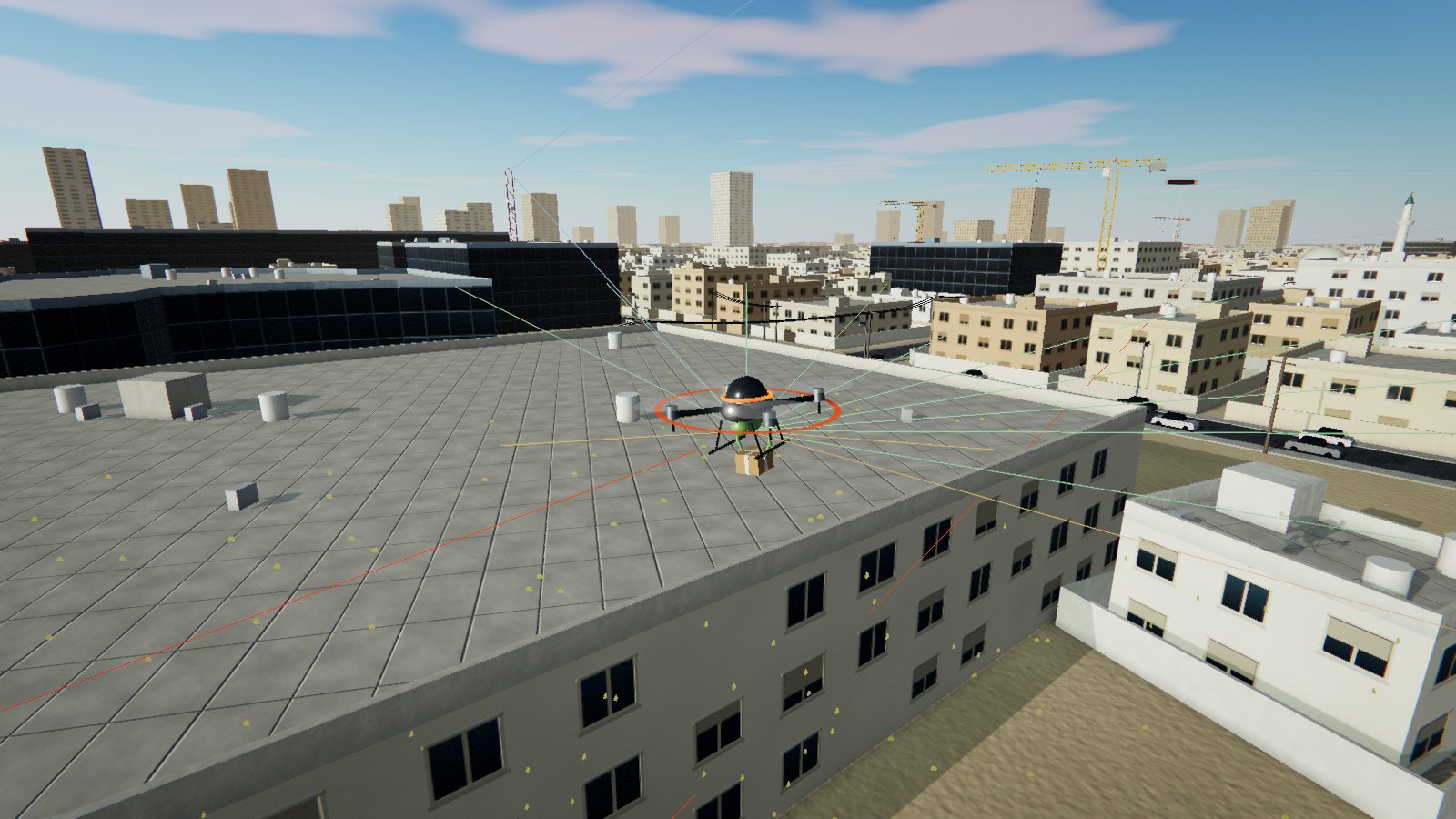 A frame from the simulator — golden hour over Al Wurud
From an order to a roof
The paper's delivery flow, runningOrders in an app, gets a unique ArUco marker, and puts it on a flat spot — a roof, a balcony. The marker is the address and the signature: the drone lands on it, and only on it.
Packs to the airframe's limits and tags the parcel with the same marker. From there nobody touches a control: no pilot, no dispatcher, no route desk.
No marker in sight? The drone asks the recipient and hovers on a timer, then returns and logs why. A drone down? It raises the alarm itself and the others decide who takes over.
A swarm that runs itself
Decentralised, by constructionThere is no server deciding who flies. Each drone keeps its own table of the others, built from the check-ins it hears over the cell network: where they are, what they hold, how much battery they have left. Select a drone in the simulator and you see the swarm as that drone knows it — and how the picture goes stale when messages stop arriving.
Take every tower down and the drones fall back to passing messages among themselves, hop by hop. Fail a carrier in mid-air and watch the idle pairs bid to recover its parcel.
Every few seconds each drone tells the others its state, position and charge. Nobody collects these; everybody keeps their own copy.
Before a mission the carrier and its wingman establish a link: establish, respond, confirm, exchange goals. No reply in time and it is sent again.
While the carrier is down on the roof, the wingman circles the address and reports the pad clear.
A failing drone broadcasts where it is going down and what it was holding. The takeover is an auction among its peers, not an order from above.
Inside the simulator
Open it →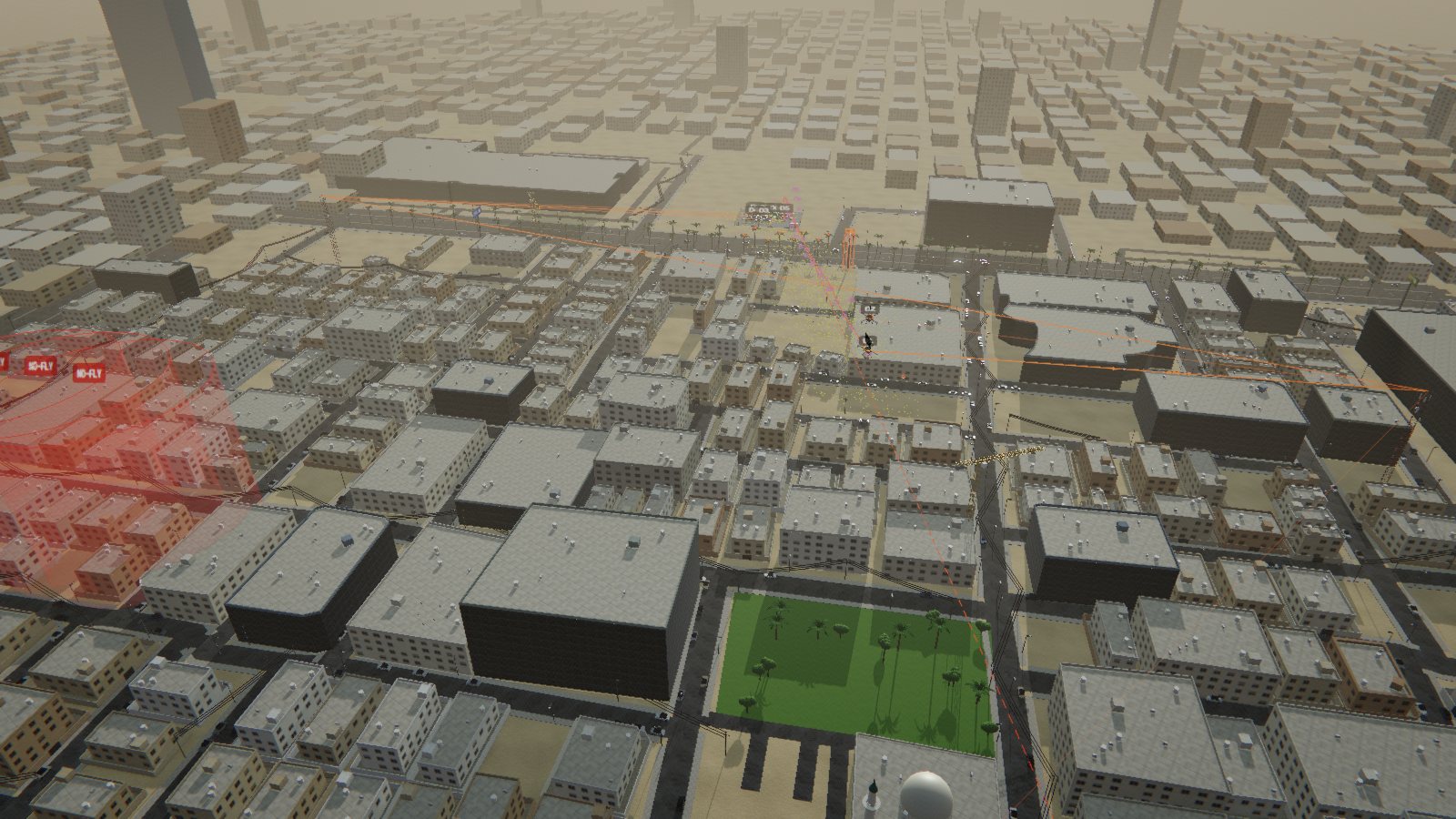 The district615 real footprints and 147 real streets. Coloured lines are routes flown, the fine dust is what the cameras have mapped, and the red cylinders are airspace the swarm keeps out of.
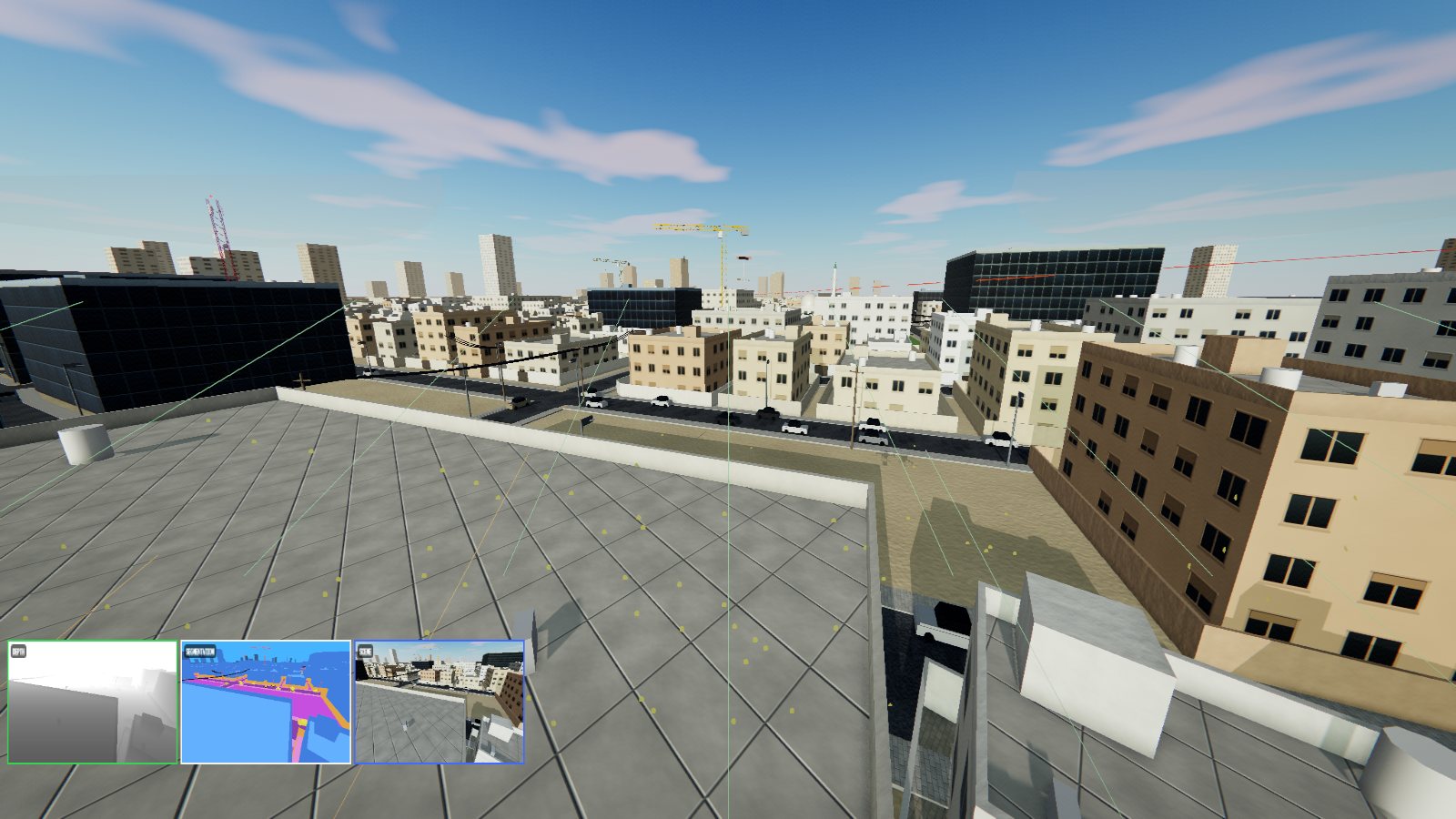 On boardRide any drone. Bottom left: its depth camera, its segmentation view and its scene camera — the three views the research ran on in AirSim.
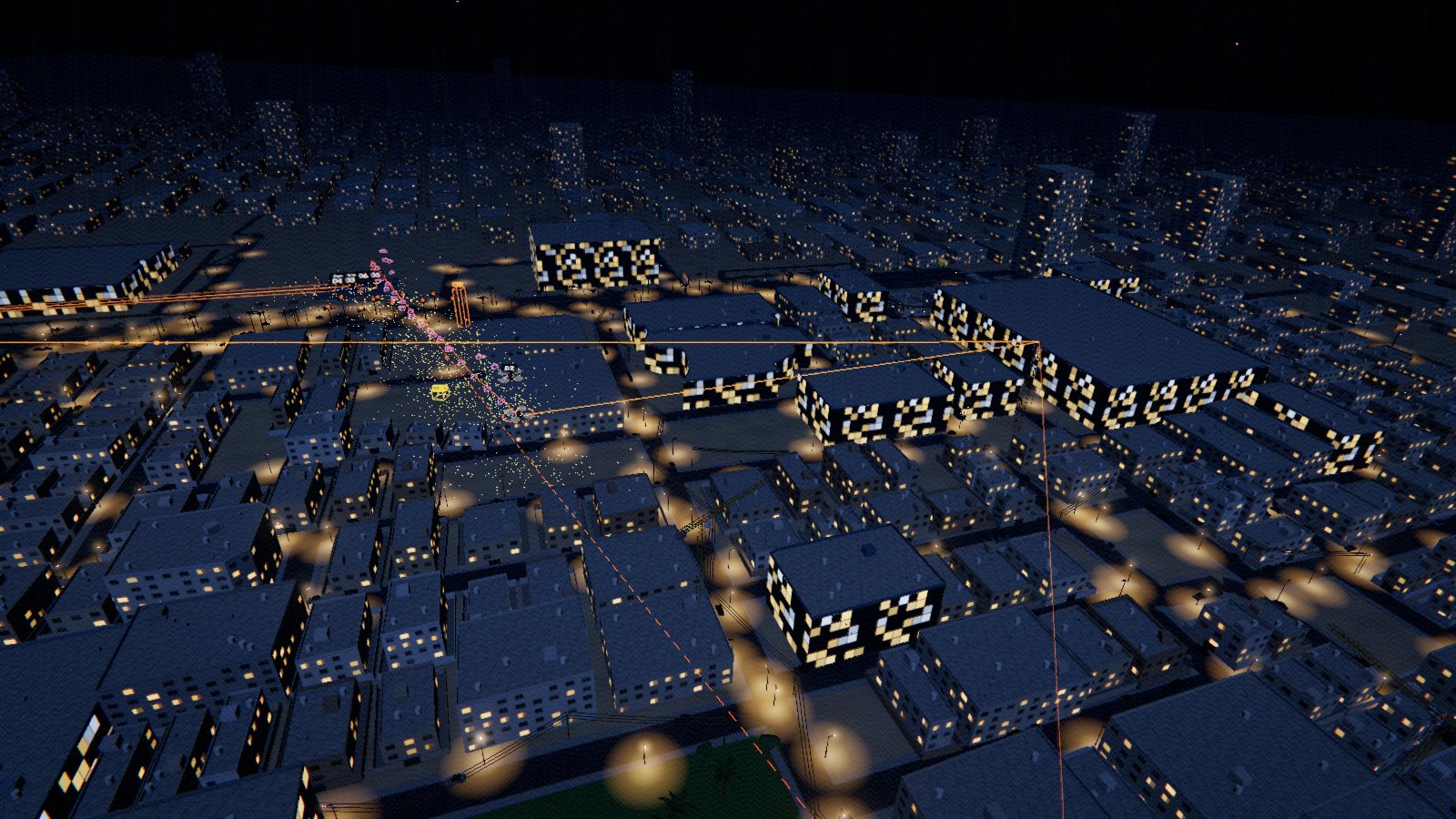 After darkAny hour of the day. The sun moves, the street lamps come on, and a pair's lights tell you who is carrying and who is watching.
Four ways to not hit things
And a framework that picksA map only knows footprints. Lamp posts, power lines, palms, tower cranes, a minaret, a flock of birds — a drone has to see those for itself. The paper's answer is not one avoidance algorithm but a framework that switches between four, depending on what the drone is looking at.
The default is a TD3 agent trained with prioritised replay: a small network that turns a depth image into a velocity. In the simulator that network is the real one, from the project's training runs, and the Algorithms tab shows its output as it flies.
| Table 4 of the paper | Delivery accuracy | Efficiency | Collision avoidance |
|---|---|---|---|
| Proximity avoidance | 0.95 | 0.88 | 0.92 |
| Dynamic path planning | 0.92 | 0.85 | 0.89 |
| Visual-SLAM integration | 0.96 | 0.91 | 0.94 |
| The framework | 0.97 | 0.93 | 0.95 |
The training runs, as logged
Six agents · 14,141 episodes · AirSimDrawn from the project's own training logs, smoothed with a moving average. Each episode is one attempt to fly a 57-metre street without touching anything. RA2C and R-DQN never reach the end of it. Over its last 300 episodes TD3 with prioritised replay finishes 42 % of the time — the best of the agents whose logs record outcomes — which is why it is the default. PPO's log keeps distances only.
20 kg
200 km
100 km/h
25,000 mAh
10 litres
The airframe of the paper's design section: a quad in X configuration with a hybrid power source, a protective dome over the flight computer, and two manipulator arms for the parcel. The drones in the simulator are built to it.
The research behind it
DecentraliDrones began as a research project and became a peer-reviewed paper: a delivery system in which drones fly in pairs, land on ArUco markers, map with visual SLAM, share their waypoints, and hold the swarm together through check-ins rather than a control room. It was trained and flown in Unreal Engine with AirSim.
This web version keeps the system and swaps the workstation for a browser: the neighbourhood is a real one, the swarm's protocol runs message by message, and the trained actor flies on a depth camera rendered on your own graphics card.
DecentraliDrone: A decentralized, fully autonomous drone delivery system for reliable, efficient transport of goods
Alexandria Engineering Journal 88 (2024) 1–30. Open access (CC BY-NC-ND 4.0).
DecentraliDrones for your fleet
The simulator is free to fly. For a logistics operator, a hospital group, a campus or a compound we build the real thing around your district: your map, your airframes, your airspace rules — first as a digital twin you can test against, then in the air.
Place an order
Pick a roof in Al Wurud. The swarm does the rest — and you can ride along, read its messages, or knock a drone out of the sky and see who picks up the parcel.